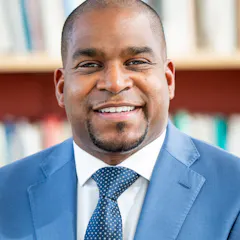
Aaron Ross Powell: Welcome to the Liberalism.org Show. I'm Aaron Ross Powell, Senior Director of Liberal Projects at the Institute for Humane Studies. What kept Black thinkers faithful to American democracy through slavery and Jim Crow? On this episode of the show, Jason Canon talks with Melvin Rogers, the Edna and Richard Salomon Distinguished Professor of Political Science at Brown University and author of The Darkened Light of Faith, about the tradition running from David Walker and Frederick Douglass to W.E.B. Du Bois and James Baldwin. They explore why these figures insisted on freedom and equal regard even without evidence it could be won, the difference between democratic faith and ordinary hope or optimism, and why Baldwin asks us to measure progress not by redemption, but by how honestly we confront a history that never fully leaves us.
Jason Canon: Melvin Rogers, you once wrote that your father attributed your success to how you looked at things. What did he mean by that?
Melvin Rogers: That's a heavy question to start with, isn't it? So the context in which he said that we were at the Katie Couric Cancer Center, and we had just seen the oncologist, and things were looking grim. And we were waiting in the lobby. My sister was handling some paperwork. And my father wasn't a man of many words, but this was one of his reflective moments. And I think what he was trying to get at is that some of what we see in front of us or what is possible for us partly depends on the angle of vision that we assume. And my father, growing up, not because he was trying to defeat any of my dreams, but he had very specific ideas about what he thought the world would permit me to do. I mean, he was born in 1932, and so he wasn't trying to defeat my dreams. He was trying to give me a stable and realistic foundation. And what he came to realize in that moment as he was reflecting was that that perspective that he had hoped that I would acquire, that he was glad that I didn't, that he was glad that I sort of could see a possibility beyond the life that he had given me or that he had lived, a life that had given me so much, that enabled me to sort of see beyond.
Jason Canon: I ask because that theme of interpretation as agency runs throughout your book. Can you unpack that for us and tell us how those are connected?
Melvin Rogers: Yeah, I mean, that's a very, very good question. I think in the context of the book, if we sort of think about it in a more sort of scholastic way, right? Given that many of the earlier figures that I deal with in this book, David Walker, Maria Stewart, Frederick Douglass, these kind of figures, they are mired in conditions of domination and oppression. And it is not immediately clear that given that context, they should be able to see a life for themselves in which they are free and they are equally regarded by their fellows. And yet they do. And this, of course, has everything to do with the power of the imagination that is fueled by the basic human desire not merely to live, but to flourish. And that then forces the political and intellectual actors to redescribe their situation such that the vision that they have is at variance or at odds with the world that they find themselves living in. And now they ask themselves, "Well, now how are we gonna bring these things in alignment?" And what's their answer? So their answer is to insist that the meaning of freedom means that one ought not, should not live at the arbitrary mercy of another, right? So I place them within the broader political philosophical tradition of republicanism, and that the way you secure that is by living in a community that regards you as an equal, not merely legalistically or procedurally, although that's very important, but that regards you as an equal as a feature of the citizenry's own identity, meaning that who I take myself to be as a citizen already enjoying rights is bound up with seeing you as someone who can enjoy it as well. And if it is diminished for you, then in some ways my commitment and my own standing is diminished.
Jason Canon: The book asks how these thinkers somehow managed to never lose faith in American democracy despite everything that they endured. Can you talk about the source of that faith?
Melvin Rogers: So some of the thinkers in the book are more religious than others. And one of the things that I tried to sort of underscore is the way in which their relationship, let's say the earlier thinkers, someone like David Walker, the relationship to God is not doing the most work. That is to say, God created us, God enabled us with capacities, and that's full stop. Now it's up to us on Walker's account and all of the thinkers that follow to lay claim to those capacities and fully activate them. And these figures are inescapably committed to the proposition that to live a human life is to live a life that is free and that is regarded as an equal, and that those commitments exist even in the absence of evidence that would suggest it can be realized. Because were those commitments not insisted on by actors, were they compromised in some sense by the actors, something of constitutive significance of being a human being would be lost. And so the ground of their faith is the commitment to these ideas themselves.
Jason Canon: So what I'm hearing is that there's a certain inner commitment, a certain sort of character, or you in the book use the word soul, that's required of us as citizens independent of the situation around us. Is that right?
Melvin Rogers: Yeah. You know, because you and I have read a great deal, and we have read horrible stories of human beings in conditions of domination here in Europe, elsewhere. And you're forced to wonder how amid that darkness the human light shines through. Or to put it differently, how must you see yourself such that it becomes possible for you to understand yourself independent of the sort of negative descriptions of you that are in circulation, independent of a state actor saying that you're not worth much, right? And so there must be some inner account that is fueling you. It doesn't mean that this can't be encroached upon, and it doesn't mean that you can't become confused about your relationship to it. W.E.B. Du Bois has a great deal to say about that. But these thinkers insisted that it is there, and it is there that they stand as they launch their pleas and their appeals to their fellows.
Jason Canon: Is there one figure from the book who you think really represents doing that task well?
Melvin Rogers: I begin with David Walker. He writes this appeal in 1829, Appeal to the Colored Citizens of the World, but in particular and very expressly to those of the United States. I think that's the full title. And in some ways I'm suggesting that all of the subsequent roads lead to Walker, including the various divisions that happen in African American political thought, like, you know, Martin Delany, who goes the Black nationalist route. Well, that road leads back to David Walker in an interesting kind of way. And I do think that Walker represents for me an exemplary case of making an appeal to African Americans about what is demanded of them in the context of domination where, where they insist on their freedom and their equal regard. And I also think it is a pamphlet in which Walker is saying to his white counterparts, "You should not be surprised by this because you yourself made similar pleas, and what I am counseling to African Americans is precisely what was counseled to you by your parents against the British crown." And so I think Walker for me is the extraordinary example here, both in that description and then finally, I think he's extraordinary because it was a pamphlet. He says it's supposed to be read by every man, woman, and child, and if you can't read it, have someone read it to you. He meant for this to be maximally accessible to the public in ways that I think as we move downstream, because of the change in time periods, because of change in standards, there's a way in which the thinkers get a bit away from the public. Not far away, but the kinda maximal public accessibility that I think is at work in Walker is a hallmark of the very agency that he commends and that he thinks is present.
Jason Canon: Frederick Douglass is another one of those early figures who features in the book. What does that look like in Douglass's case?
Melvin Rogers: Douglass is a powerful heir to this sort of line of engagement that I would associate with Walker. Obviously, there are other figures around Douglass that he has in mind. You know, if Walker's initial conversation is to his Black counterparts knowing that his white counterparts are listening in, I think Douglass, at least the thread of Douglass that I'm concerned with, his most immediate conversation partner is his white counterparts, knowing that his Black counterparts are listening in. And if David Walker saves to the end of the pamphlet the plea to his white counterparts, "Do you not understand the meaning of your Declaration of Independence?" That question is so central to many of the writings of Frederick Douglass, of course, the classic Fourth of July address that he delivers in Rochester. And what Douglass thinks is possible is that because of the love affair that his white counterparts have with the founders, he thinks that he can shame them into a position of moral rectitude. Can you say that you have laid proper claim to this legacy? Have you done in your time in relation to your greatest problem, right, slavery, the enslavement of, of Black folks, have you done in your time relative to that problem what they did in their time relative to their own domination? So they're extraordinary. They are great. But my matter, my business is with the present, right? And whether or not you can lay claim to it. And he's hoping that this will stimulate a positive moral reaction. And one of the things I think we need to sort of keep in mind, I just have to say this, is that these figures are writing in a time where they believed, because they could see it in various ways, they believe that their white counterparts, like themselves, were always interested in trying to be in right alignment with a set of higher order principles. And so they believed that they stood within a shared moral horizon, even if there were a great deal of confusions and deformations at work. And they also believed that because of that, their whole series of morally charged terms and ways of relating rhetorically that could stimulate reaction for so long. Think about it, for so long the abolitionist movement was a rhetorical movement. Ultimately, we got legislation, we got movement by politicians, but for a long time it was a rhetorical movement. Well, that only can work if you believe that your fellows can be moved by words because they understand that words are worlds, words are ways of relating to one's fellows. So I think Douglass is hoping for that. He believes that in the context of the Fourth of July address. And he also knows that if this new world, which I think is quite important to say, if this new world is enacted, although it is derived from language used by the founders, it would bring about a world that they themselves could not imagine.
Jason Canon: On the topic of rhetoric, I imagine that some readers might get a little hung up on the language of faith. So as you note in the introduction, faith often implies something that can't be rationally justified. How much hinges on thinking of the aspirations of these thinkers as matters of faith as opposed to hope, let's say, or optimism?
Melvin Rogers: So let me come at this at a very specific angle from within the context of the book. The nature of the politics that I say that these figures commend is a kind of, or the way to think about the form of it is a kind of aspirational politics. And that this aspirational politics is not exhausted by empirical evidence that tells against it, and it's not wholly sustained by empirical evidence that might suggest in favor of it. And I reach in order to describe, well, what's this kind of stance that they are occupying? I reach for the word faith. Now, here is where I want to be very specific. This language of faith, in contrast to, let's say, hope, which you suggest, comes out of a very specific conversation and exchange that's taken place between Martin Delany and Frederick Douglass. And the reason why this is important is because we don't need to be scholars to know that the philosophical and theological literatures on faith and hope, all of these things are so extensive. So at some point, one has to make some decisions somewhere, right? And a bit of it always seems arbitrary. So to try to lessen that, you stay with the figures that are central to the story. And Martin Delany in the 1850s writes a letter to William Lloyd Garrison, and he says, "Look, I would willingly stay and fight the good fight if there was any hope, any probability of success." Basically, he says there's no probability and therefore he has no hope. And Douglass responds to this letter. He says, "Look, we don't disagree with Brother Delany because he's interested in immigration," because that was Delany's proposal, black people leave. We really disagree is because he doesn't have sufficient faith that a black man basically would get fair hearing on American soil. So what's the difference that makes the difference between these two words? Well, it seems to me that it's very important that Delany renders hope in terms of probability, meaning that there has to be empirical markers that suggest or that support your reason for hoping. And when those things become untethered or when the, the empirical supports are not there, then your hope becomes fantasy and you become irrational, right? And I'm inclined to say that when we, in our kind of ordinary run-of-the-mill dis-discourse, use hope, we kinda mean it in this kind of way. There are good reasons to suggest things will work out for us one way or another. And what Douglass is trying to get us to see is that there are situations in which we find ourselves in which bringing about a new state of conditions that we want to occupy will sometimes involve in big moments running ahead of the evidence that you need to justify your stance, right? And it seems to me that Douglass is trying to be very realistic about what the situation looks like on the ground for the enslaved. And he is suggesting that the measure of our commitment to the value of freedom and equality can't finally be settled by those conditions on the ground. And in fact, one has to run ahead of those conditions to create the context for the realization of freedom and equality, the realization of the breaking of chains from enslavement. So I understand that rhetorically, hope may work because it doesn't seem to... One might think it works 'cause it doesn't seem to have the baggage of religion. But I ultimately think that something is lost in our proper relationship to our ultimate values in the context in which we see both institutions, we see both laws, and we see people on the ground betraying those or failing to honor those.
Jason Canon: What are the practices or the habits of the heart that are needed to sustain that kind of faith?
Melvin Rogers: So throughout the book, I try to sort of basically say, you know, what is it about democracy that justifies commitment? And what I offer as I'm following these thinkers is this commitment to freedom and equal regard. Okay, well, how are you going to persuade your colleagues, your fellows, to take up this? And so then we sort of attend to different practices that these thinkers deployed in order to bring that about. Rhetoric is, is one of them, but it's also a kind of aesthetic appeal that sort of sees the self and sees the nation as an unfinished product. And then I say, but these figures know that there's no certainty to this. And so faith becomes the thing on which they're standing as they're engaged in this whole project. Your question goes after something that I think is underspecified in the book because what helps perfect or improve or fortify the workings of faith? And I don't really sort of talk about actually this, which goes to the habits of the heart, and it actually goes to a set of virtues that are not foregrounded in the book, right? So we know from all of the thinkers, as Walker is talking to Black people who are enslaved and struggling in various ways all the way down to Baldwin, where Black people are still under assault, we know that in some ways they're insisting on the virtue of courage. So at this moment, I'm going beyond the right. And there's a moment in the book where I say that the executive virtue of faith is courage, but I don't do much more than just sort of... But courage is quite important, and courage not rendered as a property of the individual self, but courage rendered as a social phenomenon, that the way in which we're able to bear the weight of this is because we stay in community, right? So all of these thinkers across time commend the necessity of solidarity as you're resisting, right? I think the other virtue that's at work is perceptual sensitivity. That to be a democratic citizen, and this is even if we're not dealing with the issue of race, but to be a democratic citizen alive to your fellows mean that you're perceptually available to them. There's a kind of sensitivity of mind and heart that must be at work so that you don't inadvertently slip into betraying the very values that you take yourself to be committed to. So think historically, I'm exceeding the book here. Think historically of the ways in which we, we have a tendency of thinking legislative victories, institutional victories settle the matter. You get an amendment for women, you get amendments for Black people, you get the Voting Rights Act, and, and it settles matters. And that tendency, and I can't blame us for saying, "Look, we wanna get on with things." Yes, that did settle it. But the tendency is to dull our perceptual sensitivity, our aliveness to the ways in which laws and institutions are not final safeguards against our tendency toward mistakes, toward betrayal, or toward moral blindness. So I think perceptual sensitivity is at work there. And perceptual sensitivity is tied to another virtue, which I do mention in the book and is actually quite substantial, which is, and it comes out in Baldwin, which is a kind of sympathetic orientation. And I'm just following Du Bois's language. And to sort of try to sort of inhabit the position of your fellows in order to understand what the claim is and what is required to respond in terms. There's technical differences between sympathy and empathy, but we'll put those to the side for a moment. But I think these are some of the habits of the heart, the habits of the mind that I think are important to help perfect the workings of faith itself, 'cause faith is hard.
Jason Canon: At the end of the book, you discuss how James Baldwin asks us to disentangle transformation and progress from redemption. What's that mean in practice?
Melvin Rogers: The United States is a nation that loves redemption. That is to say, we are interested in having the work that we do insofar as we're explicit about it being a response to a misstep, a betrayal that the nation, previous actors have engaged in, seeing that response as having settled the problem, right? We have redeemed ourselves in light of the error that was made, maybe by ourselves, maybe by our parents. And one of the things that Baldwin sees and what he's trying to get Americans to understand is that there are some harms that run so deep and become so constitutive of the nation that what you have in its wake is a nation and a people that have been traumatized. And that what you can do in response to that has nothing to do with redemption. It has everything to do with what are the tools that we're going to acquire, what are the institutions we're gonna put into place, what are the sensitivities we're going to cultivate that help us manage the workings of this trauma and then try to hold it at bay. And when we shift from thinking about progress, or measuring progress in terms of redemption, to understanding progress in terms of how we manage and hold at bay trauma. Baldwin thinks that practically what this means then is, is that we then begin to sort of think of our relationship not in terms of some determinate law or some determinate institution. We begin to think about the quality of our relationship based on the skill with which we deploy and we use to sort of manage this ongoing trauma. And Baldwin wants to insist that that shift is okay, and we can be okay with it. That is to say, we need not read that as a strike against the national character, right? But the national character constantly trying to be mindful of its own tendencies. And suddenly it seems to me there's a great deal that one can say and do in the light of that. How might it encourage a different kind of politics in the United States with respect to race if we rejected the thought that any particular law we pass would settle the matter? And that rather we are constantly managing the workings of our past that is always threatening to intrude on our present, and that is a measure of what we are committed to, right? Black and white, all of us, right? If we just sort of use that binary, right? That's what we're committed to. And that then becomes the expression of who we are. It seems to me that that generates a very different kind of orientation and relationship to the work that we're doing. Suddenly, I think reparations will look differently because now the way in which it's sometimes discussed, reparations is a kind of one and done thing. Well, no, that's not right. And reparations is always directed toward Black people rendered in monetary terms. That's not precisely right either, because the nature of the repair has to cut in both directions. Now, what would that look like? Practically, we would have to work through that, but we can't even begin to work through that if we don't have the proper orientation and the proper framing to it. And so one of the things I think, and I'll stop on this point, one of the things I think that the book commends, especially in the chapter on Baldwin, is that you don't get a set of policies, you don't get a set of institutions. What I do think that they offer is something deeper, which is about what would our orientation be given that this is our history? And what must that orientation be if we mean to do right by our commitment to freedom and equal regard, right?
Jason Canon: And this takes us back to the beginning where we started in this conversation, because what I'm hearing is that a way of relating to our history, a way of relating to our understanding of our history can be freeing. Is that right?
Melvin Rogers: Yeah. Yeah, I think that's right. You know, in the same way that my father came to understand that his way of relating to his history was useful to him, but it wouldn't be especially useful for me. And so he was quite happy that on this point, I decided to see beyond his way of seeing things. And yet one of the things that is obscured here is that my ability to see beyond is not simply a function of the power of my will, right? It is a product of the ways in which my father and mother, perhaps unbeknownst to themselves, perhaps intentionally in some ways, shaped me, right? And so to properly honor him is not to do as he says. It is in some ways to sort of violate that as a way to extend his very legacy, of course, through my life, which then of course has its own distinctive flair that I can claim as my own, right? And when you think about these figures and their relationship to the founders, there are moments where all of these figures can engage in their own idolatrous relationship to the founders and obscure the radical propositions they're putting on the table. What I try to sort of emphasize in the book is the more radical proposition that they're putting on the table, which in some ways appropriates the revolutionary spirit of the founders and the framers, but appropriates its, like, ends that are not precisely commensurate with them. And in some ways, they sort of walk in the footsteps of the framers and the founders without simply recreating the path that they took, right? Of course, the metaphor begins to break down at a certain point, but this has something to do with the ways in which we think about how activists channel the revolutionary energy of past actors that they claim as their inheritance.
Jason Canon: When you look at the state of America in 2026, what are the most important lessons that you think these authors bring to our moment?
Melvin Rogers: I think one of the things that comes through very powerfully is that these figures from Walker to Baldwin with Anna Julia Cooper, Ida B. Wells in the middle, they insisted that we have to disentangle freedom from sovereignty and understand that freedom always meant vulnerability. And because it meant vulnerability, the way you manage that vulnerability is in community. You can't escape it. You can't deny it. You can't get around it. You have to take seriously that modern freedom creates the condition for us to construct the world that we want, the communities we want to inhabit. And yet that same freedom means that we often have to bear witness to the inadequacies of our creations to respond to the problems that we find ourselves confronting. And the reason why I say that this matters for our present moment is that we are dealing with a political atmosphere of a particular party that is very concerned about being vulnerable. And it's rendered through the idiom of whiteness in various ways. We hear the language of demographic shifts and replacement theory and right. All of this is an attempt to hold on to the false idea that freedom and sovereignty must go together, freedom and mastery must go together. And that somehow freedom and vulnerability going together means you're not free at all. And so my sense is, is that one of the spheres in which our politics has taken place is over the very understanding of what we mean by being a free community and how we're going to go about securing that. And we have one older world that's insisting that has everything to do with mastery that is tied to racial identity, particularly whiteness. And we have another tradition that is suggesting that no, that is not what it's about at all. It is about attending to each other together and that that ought not to be understood as weakness, but the highest expression of what modernity has given to us. It is unsurprising that this older tradition, several of its defenders pitch it in the form of a kind of dark enlightenment, which really is a rejection of the enlightenment. This is one of the critical lessons that I think come out of the book, this tradition, if you wanted to apply it or think about our present moment through the kind of narrative that I offer up.
Jason Canon: All right. Our final questions. What are you working on now?
Melvin Rogers: Related to these themes, I'm working on a book I've titled Beyond Origin Stories, Democratic Faith and Its Burden. And it is an attempt to sort of give the faith that we've been talking about now called democratic faith to give it somewhat of a kind of independent philosophical standing. So it's not written in the idiom of the history of political thought. It has a kind of first order interpretive register and it unfolds against the backdrop of what I take to be our idolatrous relationship to origin stories. And there I focus on some of the thinkers that populate this book. And now I focus on those moments when they do become a bit blind to their relationship to the founders. And so chapter one is on origin stories. Chapter two is on a defense of democratic faith as a response to what I think to be a misdescriptional and misplacement of commitment. And then chapter three is a historical example that I think exemplifies the kind of democratic faith I have in mind and the kinds of virtues that this democratic faith commends.
Jason Canon: What book have you read recently that you can't stop telling people about?
Melvin Rogers: So the book is not yet out, but I have been talking up Jack Turner's forthcoming book, Die Your Own Death, which is on Walt Whitman's existential democracy. And for those who will have read The Darkened Light of Faith, my book, the last chapter is gesturing in this direction of how to sort of think existentially of one's relationship to democracy. And I think Jack Turner does this really extraordinary job in giving us an interpretation of Whitman and what Whitman was trying to help us come to grips with how central death is, not simply to the ending of life, but to the very living of it and which pieces of us need to die off so that we can grow into our humanity. And to grow into your humanity means and to let these things die off means that you got to learn how to do that. And that itself requires instruction. It requires a kind of pedagogy. And so he sort of narrates this through Walt Whitman. Jack, Chip, we've been further along. He won't want to say this, but this is a species of what we might call American perfectionism that runs through the Emersonian tradition that would include Douglass, which is about how do you allow the soul to ascend? Well, one feature of it is that the soul has to allow pieces of it to fall off that are not conducive to being in community with others and sustaining the kind of democratic vision that it claims to be committed to. I have the manuscript, so I've been going back to it and rereading it. It's short in terms of length, but it is so substantively rich that you really can stay with a chapter for hours, just kind of not figuring out what's going on, but really sort of thinking about, well, what's entailed by this?
Jason Canon: When you think about the future of American democracy, what sustains your faith?
Melvin Rogers: I don't want to seem cliche or corny about this, but I always see faith in the eyes of others. For me, that's the touch of divinity that the sort of sense of it that I bear witness to. And I think when you reflect, for example, on the various ICE raids that have been taking place around the United States, if you think about Minnesota, I think the extraordinary power of human beings to say, no, this is not going to happen here, even as it is happening here, and resist. That suggests to me the human will refusing to submit to domination. It may not win. It may lose, but it's there and it has to be dealt with. And that gives me faith.
Jason Canon: Melvin Rogers, thank you.
Melvin Rogers: Thank you, Jason, so very much for having me on.
Aaron Ross Powell: If you enjoyed this conversation between Melvin and Jason, you can find more like it, along with original essays from contemporary liberal scholars at www.liberalism.org.



 Apple Podcasts